Xiaomi 17 vs Xiaomi 14: What Changed in the New Flagship
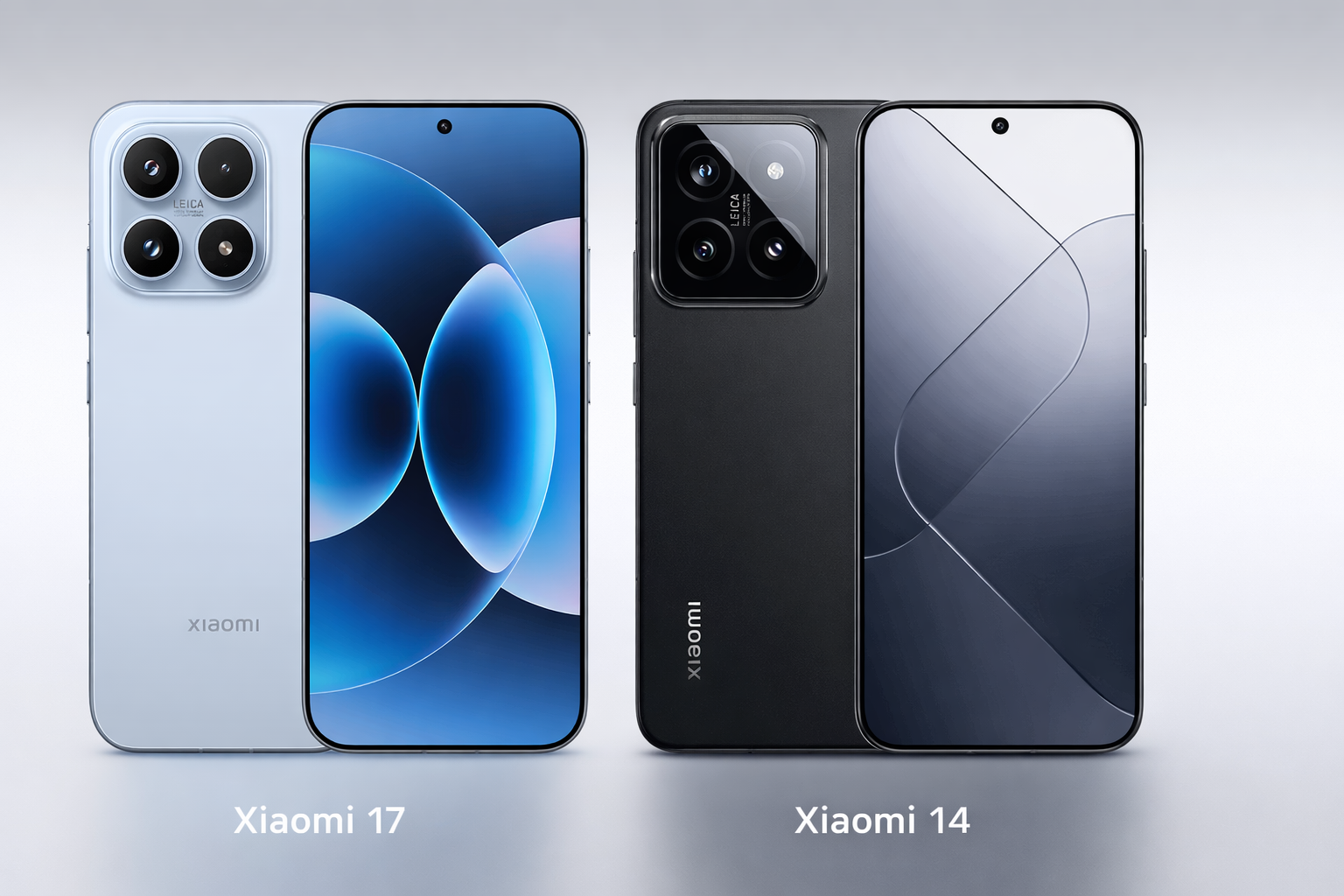
The Xiaomi 17 looks like a logical continuation of the previous generation, but a detailed comparison reveals several important changes. A new Snapdragon processor, updated Leica camera, and optimized HyperOS system are designed to make the flagship faster and more stable.
What’s New in Xiaomi 17 Compared to Xiaomi 14
When Xiaomi releases a new generation of flagships, the company rarely changes everything at once. Most often, the manufacturer works with targeted improvements: performance, camera algorithms, power consumption, and system optimization. That’s why the Xiaomi 17 looks not like a revolution, but like a very thoughtful evolution of the Xiaomi 14’s ideas.
The Xiaomi 14 was already one of the strongest compact flagships on the market. It combined a powerful Snapdragon, Leica cameras, and a very fast system. But the Xiaomi 17 tries to go a bit further: the smartphone gets a new processor, optimized HyperOS, improved photo processing, and changed power consumption logic.
Main Advantages of Xiaomi 17:
- New generation Snapdragon processor provides higher performance and better energy efficiency
- Improved Leica camera algorithms deliver more accurate color reproduction and stable night shooting
- Updated HyperOS system works smoother and manages memory faster
- Optimized power consumption allows the smartphone to work longer under identical loads
- Battery increased from 4610 mAh to ~5000 mAh
- New interface logic makes the system more stable during multitasking
Technical Specifications: Comparison Table
| Specification | Xiaomi 17 | Xiaomi 14 |
|---|---|---|
| Processor | New generation Snapdragon (updated architecture) |
Snapdragon 8 Gen 3 |
| RAM | 12 / 16 GB LPDDR5X | 12 / 16 GB LPDDR5X |
| Storage | 256 / 512 GB / 1 TB UFS 4.0 | 256 / 512 GB / 1 TB UFS 4.0 |
| Display | AMOLED 6.36″, 1–120 Hz, Dolby Vision | AMOLED 6.36″, 1–120 Hz, Dolby Vision |
| Main Camera | 50 MP Leica (updated processing algorithms) |
50 MP Leica |
| Telephoto Camera | 50 MP optical zoom | 50 MP optical zoom |
| Ultra-wide Camera | 50 MP | 50 MP |
| Battery | ~5000 mAh | 4610 mAh |
| Fast Charging | 90W wired, 50W wireless | 90W wired, 50W wireless |
| System | New generation HyperOS | HyperOS |
| Protection | IP68 | IP68 |
| Positioning | updated compact flagship | compact flagship |
Performance: Snapdragon and Real Speed
When a new generation flagship smartphone is released, the main change is almost always the processor. It determines the speed of the system, photo processing, stability in heavy games, and the efficiency of artificial intelligence operations.
The Xiaomi 14 runs on the Snapdragon 8 Gen 3 — one of the fastest mobile processors of its time. This chip easily handles any modern tasks: from complex games to photo and video processing. The Xiaomi 17 gets a new generation Snapdragon with improved core architecture and higher energy efficiency.
Key Performance Changes in Xiaomi 17:
- Faster app launches and task switching
- Stable performance in heavy games without frame rate drops
- Faster photo and video processing
- Better AI algorithm performance
- Lower heating during prolonged loads
An important role is played not only by the processor itself but also by system optimization. HyperOS in the Xiaomi 17 gets more aggressive memory management and distributes resources more efficiently between apps. As a result, the smartphone responds faster to user actions and maintains stable performance longer.
Leica Camera: Is There a Difference from Xiaomi 14?
The camera has remained one of the main arguments in favor of Xiaomi flagship smartphones for several years. The partnership with Leica allowed the company to change its approach to photography: instead of aggressive image processing, more natural colors, better contrast handling, and more predictable results in complex scenes appeared.
The Xiaomi 14 already showed a very strong result in photography. In the Xiaomi 17, the company doesn’t try to completely change the camera system. The main changes occur in the software part: new Leica algorithms, faster photo processing, and more accurate color work.
Camera Improvements in Xiaomi 17:
- More accurate Leica color reproduction
- Better handling of high-contrast scenes
- Stable night shooting with less noise
- Faster photo processing thanks to the new processor
- More natural portraits
In real use, these changes become noticeable specifically in difficult conditions. Daytime photography between generations looks very similar, but in the evening or in low light, the Xiaomi 17 can slightly better control noise and details.
Battery Life: Power and Usage Time
The Xiaomi 14 already showed very good autonomy for a compact flagship. The 4610 mAh battery combined with an efficient processor allows the smartphone to easily work a full day of active use.
In the Xiaomi 17, the company tries to improve this indicator not only by increasing the battery to ~5000 mAh but also by optimizing power consumption.
Battery Life Changes:
- Optimized power consumption of the new processor
- Slightly larger battery (+~400 mAh)
- Better HyperOS optimization
- Lower energy consumption in standby mode
- More stable autonomy during active use
In everyday scenarios, the difference between generations doesn’t look dramatic. But the Xiaomi 17 can work a bit longer under the same tasks: video viewing, social networks, navigation, or photography.
Should You Upgrade from Xiaomi 14 to Xiaomi 17?
When a new generation of smartphones is released, most users ask the same question: is there any point in switching to a new model if the previous one still works well. In the case of the Xiaomi 17, the situation is not so straightforward because the Xiaomi 14 remains a very powerful flagship.
The Xiaomi 14 runs on the Snapdragon 8 Gen 3 processor, has Leica cameras, fast charging, and a compact body. In terms of performance, it still ranks among the fastest Android smartphones. Moreover, the model receives long-term system support. The company promises four major Android updates and five years of security patches, meaning support until early 2029.
The Xiaomi 17 brings other changes. The smartphone gets a new generation Snapdragon processor, improved image processing in Leica cameras, and other camera algorithms. Xiaomi also updated the HyperOS system and extended the support period for the flagship series.
Upgrading to Xiaomi 17 Makes Sense in Two Cases:
- If you need the maximum performance of the new processor
- If the latest Leica camera with new photo processing is important to you
- If battery life is critical — the larger battery provides a noticeable advantage
If the Xiaomi 14 is used for everyday tasks — social networks, photos, video, or games — the difference with the Xiaomi 17 won’t be critical. The previous model remains very fast.
Conclusion: The Xiaomi 17 is an evolutionary but very thoughtful update. For Xiaomi 14 owners, the upgrade isn’t mandatory, but if you’re choosing a new compact flagship, the Xiaomi 17 offers better future-proofing thanks to the new processor, improved camera, and increased battery.