New Windows 11 Restrictions: TPM 2.0 Bypass Will Soon Be Impossible

With the introduction of Windows 11, users with older computers faced challenges due to the requirement for TPM 2.0 (Trusted Platform Module). For such devices, a workaround was found that allowed users to bypass the TPM check using specific commands, enabling the installation of the new operating system on unsupported PCs. However, Microsoft is actively working to eliminate these vulnerabilities.
Recently, a new patch was discovered in the Canary build, which mandates the presence of TPM 2.0 for installing Windows 11. While the current version of Windows 11 24h2 still supports bypass methods, the upcoming Windows 11 Insider Build 27686 (Dilithium) will render this method ineffective. This means that users with older PCs will no longer be able to install or update Windows 11 without TPM 2.0 support.
Microsoft is gradually closing all avenues to bypass TPM 2.0. For example, the recently released PopCnt build has already blocked many of these workarounds. Previously, users utilized special software to bypass TPM and Secure Boot checks on older processors, such as Athlon and Core2Duo, allowing system updates without a physical TPM module.
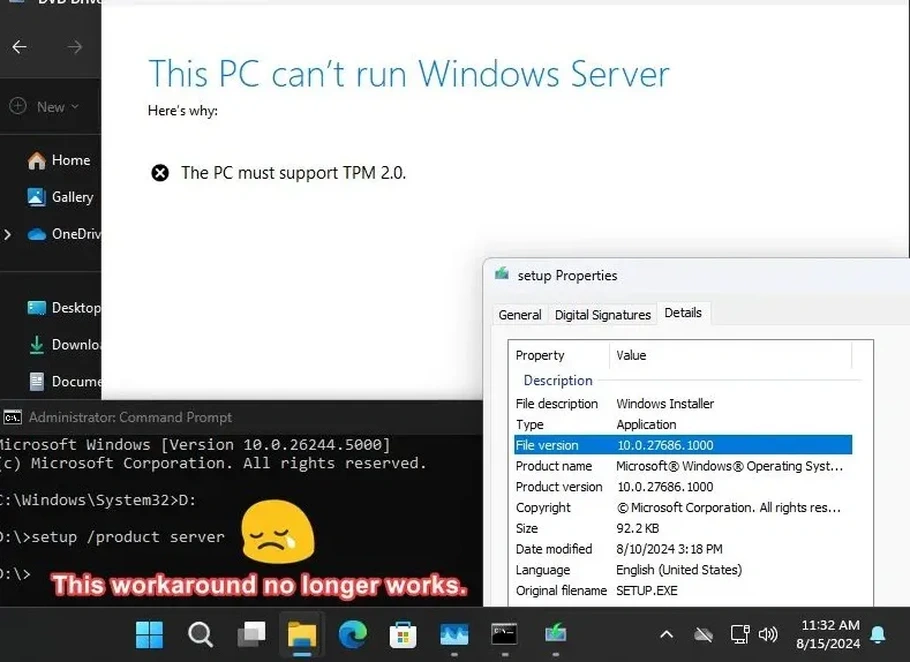
New Windows 11 Restrictions: TPM 2.0 Bypass Will Soon Be Impossible
While installing TPM on older laptops is not feasible, even users with relatively new processors face the issue of their devices not being officially supported for Windows 11. In the new update, Microsoft did not explicitly mention fixing the vulnerability, but it was observed in the latest Canary builds, and it is likely that all future updates will also block TPM 2.0 bypasses.
Thus, current bypass methods remain a temporary solution, and Microsoft continues to work on closing these loopholes.